Groundwater Observatory
A fully instrumented riverside aquifer test field in Pirna-Copitz, operated by TU Dresden since 2008
About
The TUD Groundwater Observatory is a real-world aquifer laboratory for applied hydrogeology. It allows researchers and students to test experimental field methods on a well-characterised, river-coupled aquifer, supporting post-graduate training and international collaboration on sustainable groundwater management.
Research
Explore digital tools supporting groundwater modelling, data visualisation and analysis, scenario evaluation, and innovative groundwater management research.
Education
Access interactive learning resources, training materials, and practical tools for groundwater teaching, capacity development and development of hydrogeological courses.
Collaboration
Connect with other researchers and groundwater professionals through shared data modelling platforms and collaborate on groundwater research and innovation.
Location
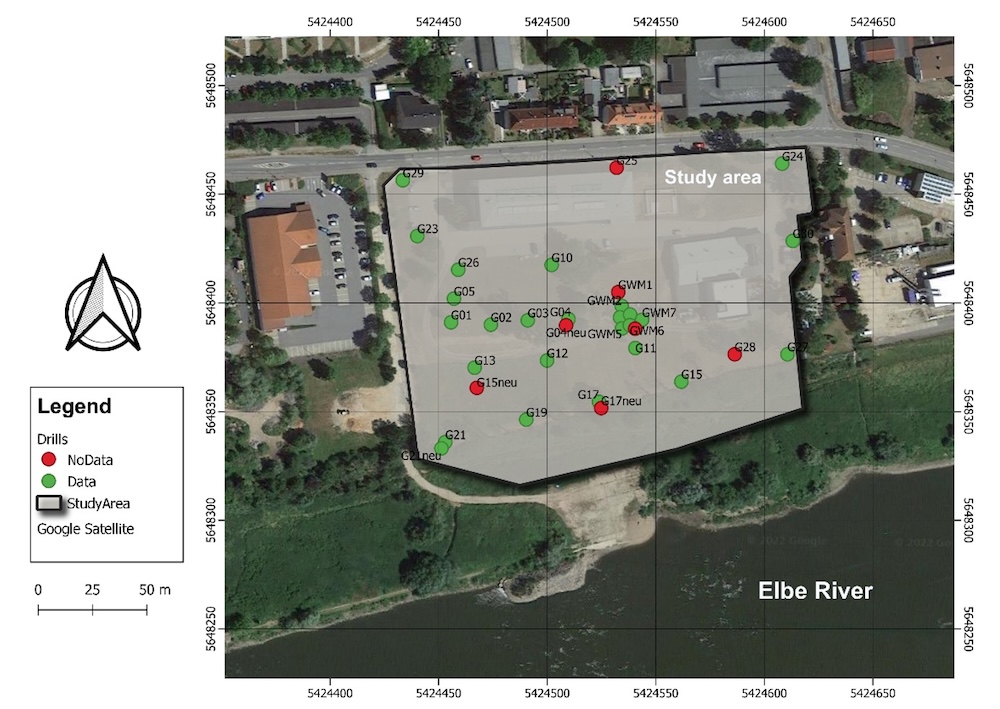
The site lies on TU Dresden’s external campus in Pirna-Copitz, Saxony, directly bordering the river Elbe, 20 km southeast of Dresden. The instrumented area covers ~2.5 ha (≈140 × 180 m) on a gentle terrace sloping from 119 to 111 m a.s.l. toward the river.
History
The site, established in 2008, is a densely instrumented test field with over 18 years of continuous monitoring.
Established in 2008 as a joint initiative of TU Dresden’s Institute of Groundwater Management and the Helmholtz Centre for Environmental Research (UFZ), the site has since grown through successive expansion into a densely instrumented test fields, with 18+ years of continuous monitoring.
See full timeline →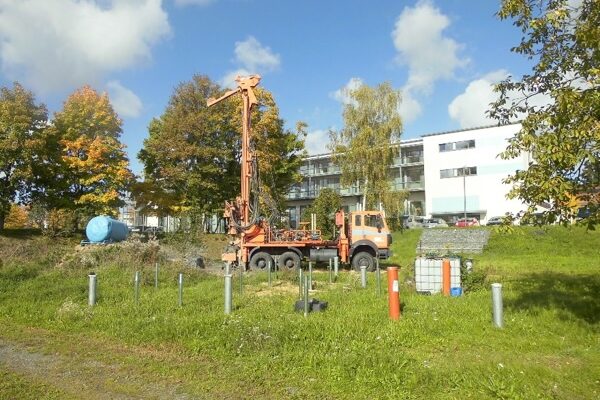
Subsurface characterisation
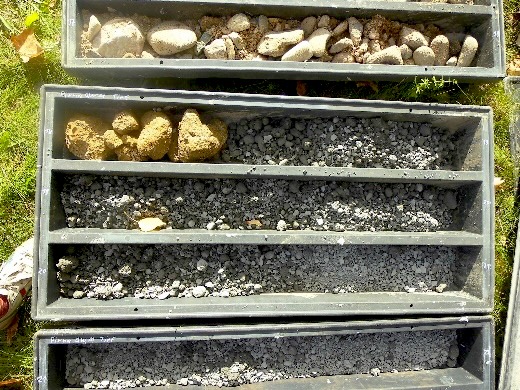
Hydrostratigraphic characteristics of the groundwater test field
Below anthropogenic fill, conductive sands and gravels form the upper aquifer to ~16 m. A 50–60 m clayey-silty Cretaceous layer separates it from a deeper confined chalk aquifer. Groundwater sits ~7 m down (ranging 4–10 m) and can move up to 2 m per hour.
Download data →Monitoring network
The site spans the full aquifer system, from shallow direct-push observation wells to pumping wells and a deep observation well into the Cretaceous.
| Type | No. | Depth | Screen | Ø | Purpose |
|---|---|---|---|---|---|
| Small-diameter, direct-push wells | 41 | 14 m | — | 1″ | Levels, flow field, tracer monitoring |
| Wells for multi-parameter probes | 7 | 14 m | 10-13 m | 5″ | Level, O₂, EC, pH; tracer & slug tests |
| Pumping wells | 2 | Full thickness | 10-14 m | 10″ | Pumping tests, recharge, bank filtration |
| Deep well (Cretaceous) | 1 | 55 m | 50-53 m | 5″ | Deep aquifer monitoring |
Monitoring devices
Monitoring and field devices for hydrogeological research
Beyond the fixed network, the site is equipped for the full range of field hydrogeology: submersible and deep-well pumps (to 100 m³/h), single- and multi-parameter probes (Solinst, UIT, HT-Hydrotechnik), packer and pneumatic slug-test systems, dataloggers, water-level meters, and samplers for conservative and reactive tracers.
Download data →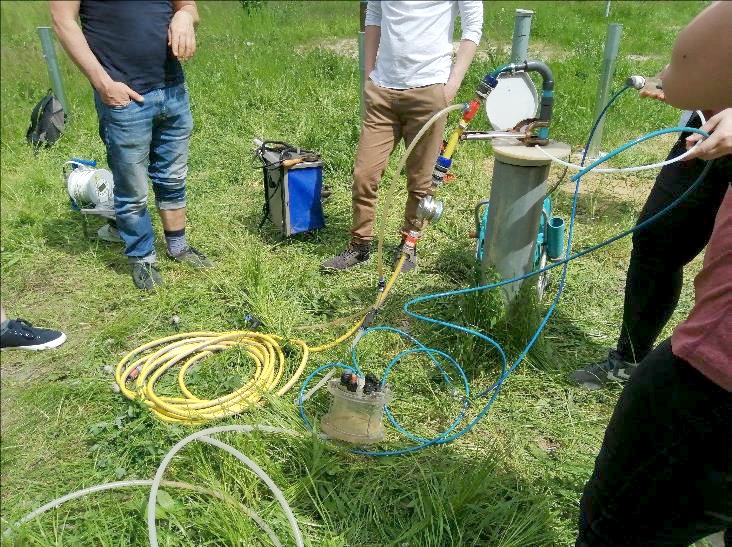

Meteorological station
Climate monitoring and groundwater response
An on-site weather station continuously records air temperature, solar radiation, relative humidity, precipitation, and wind speed and direction, linking rainfall directly to groundwater response.
Download data →Download
All datasets are openly accessible. Live and historical data are published as interactive dashboards under a CC BY 4.0 licence, and the site can be explored remotely via a 360° virtual tour. The results of aquifer testing can be downloaded from Zenodo.
Time series
Datasets with water levels and quality measurements in our groundwater monitoring wells, including results of different tests.
Download →Borehole logs
Detailed borehole logs with lithological descriptions, stratigraphy, groundwater observations, and drilling information from field investigations.
Download →Kr-DPSIL profiles
Vertical Kr-DPSIL profiles for high-resolution characterisation of vertical stratigraphy, sediment heterogeneity and anisotropy.
Download →Grain size distribution
Grain size distribution datasets and laboratory analyses, including sieve and hydrometer analyses.
Download →Vertical EC logs
Depth-dependent measurements of the electrical conductivity (EC) and boreholes for geological layering, analysis of sediment compositions and water salinity.
Download →HPT soundings
Hydraulic Profiling Tool (HPT) investigations using direct-push techniques to measure permeability of soil layers before or after wells’ construction.
Download →Direct-push slug tests
Rapid, cost-effective hydrogeological methods used to estimate the hydraulic conductivity (K) of shallow, unconsolidated aquifers.
Download →52
Observation points
21
Bore profiles
18
sensors
5
IOT sensors
Publications
Scientific publications resulted from research activities conducted at the TUD Groundwater Observatory
Händel, F., Binder, M., Dietze, M., Liedl, R., & Dietrich, P. (2016). Experimental recharge by small-diameter wells: The Pirna, Saxony, case study. Environmental Earth Sciences, 75(10), 1–8. https://doi.org/10.1007/s12665-016-5701-7
Dietze, M., & Dietrich, P. (2012). Evaluation of vertical variations in hydraulic conductivity in unconsolidated Sediments. Ground Water, 50(3), 450–456. https://doi.org/10.1111/j.1745-6584.2011.00854.x
Sallwey, J., Glass, J., & Stefan, C. (2018). Utilizing unsaturated soil zone models for assessing managed aquifer recharge. Sustainable Water Resources Management, 4(2), 383–397. https://doi.org/10.1007/s40899-018-0214-z
Glass, J., Junghanns, R., Schlick, R., & Stefan, C. (2022). The INOWAS platform: A web-based numerical groundwater modelling approach for groundwater management applications. Environmental Modelling & Software, 155, 105452. https://doi.org/10.1016/j.envsoft.2022.105452
Fichtner, T., Barquero, F., Sallwey, J., & Stefan, C. (2019). Assessing managed aquifer recharge processes under three physical model concepts. Water, 11(1), 107. https://doi.org/10.3390/w11010107
Barquero, F., Fichtner, T., & Stefan, C. (2019). Methods of In Situ Assessment of infiltration rate reduction in groundwater recharge basins. Water, 11(4), 784. https://doi.org/10.3390/w11040784